 Quiet Lion
2026 · AI Agent outlook · Sequoia / a16z / Gartner / Quiet Lion
2026 AI Agent Outlook from Sequoia, a16z, Gartner, and Quiet Lion
In 2026 Sequoia, a16z, Gartner, and Quiet Lion are all talking about AI agents, with different emphasis. Sequoia Capital treats long-horizon agents as functional AGI—systems that can figure things out. Andreessen Horowitz (a16z) writes about product interfaces, infrastructure, and vertical software. Gartner puts Agentic AI at the peak of inflated expectations and keeps returning to proportional governance. Quiet Lion publishes monthly AI video agent traffic rankings—the latest visit read for that category. Below, each outlook first, then overlap and disagreement across all four.
Sequoia Capital: long-horizon agents and functional AGI
In January 2026, Pat Grady and Sonya Huang’s 2026: This is AGI define AGI as the ability to figure things out. The path they describe stacks pre-training, inference-time reasoning, and long-horizon agents that iterate toward a goal. Coding agents are the first clear example. On the application side they put weight on agent harnesses—memory hand-offs, compaction, and similar scaffolding. Labs push reinforcement learning to hold focus longer. They cite METR’s tracking: long-horizon task capability roughly doubles every ~7 months. For founders, products shift from chatty helpers to systems that do work: sell outcomes, move the UI from prompt boxes to delegation, and treat reliability plus feedback loops as what makes outcome pricing possible. At AI Ascent 2026, Sonya called 2026 the year of agents once models, tools, and harnesses lined up; Pat pushed customer-back moats and the diffusion gap between model capability and Fortune 500 deployment.
a16z: interfaces, agent-native infra, multiplayer
a16z’s Big Ideas 2026 is a set of themes, not a single white paper. On agents, the agentic interface means less prompting and more observation and proactive action, with human approval kept for high-stakes work. Agent-native infrastructure argues that backends built for one human request at a time break when one goal fans out into thousands of tool calls. Messy multimodal data sinks agents unless context layers stay usable. Vertical software’s next layer is multiplayer—permissions and cross-party workflows. Content and software also need to be machine-legible, not only pretty for human eyes. The multimodal and “step inside video” notes line up with Quiet Lion’s later look at video-agent product-site traffic.
Gartner: peak hype, adoption gap, graded governance
In Gartner’s public read of the 2026 Hype Cycle for Agentic AI, Agentic AI sits at the Peak of Inflated Expectations. The cited CIO survey: about 17% of organizations have deployed AI agents; more than 60% expect to within two years. Most projects stay narrow. Fully autonomous agents are not ready for most enterprise use cases. Governance, security, and FinOps for agentic AI show up alongside platforms, orchestration, ADLC, context graphs, and agent experience. A May 2026 press release is blunt: one governance model for every agent fails. Classify by autonomy—Observe, Advise, Act with Approval, Act Autonomously. Gartner predicts that by 2027 about 40% of enterprises will demote or decommission autonomous agents after governance gaps surface in production incidents.
Quiet Lion: monthly AI video agent traffic outlook
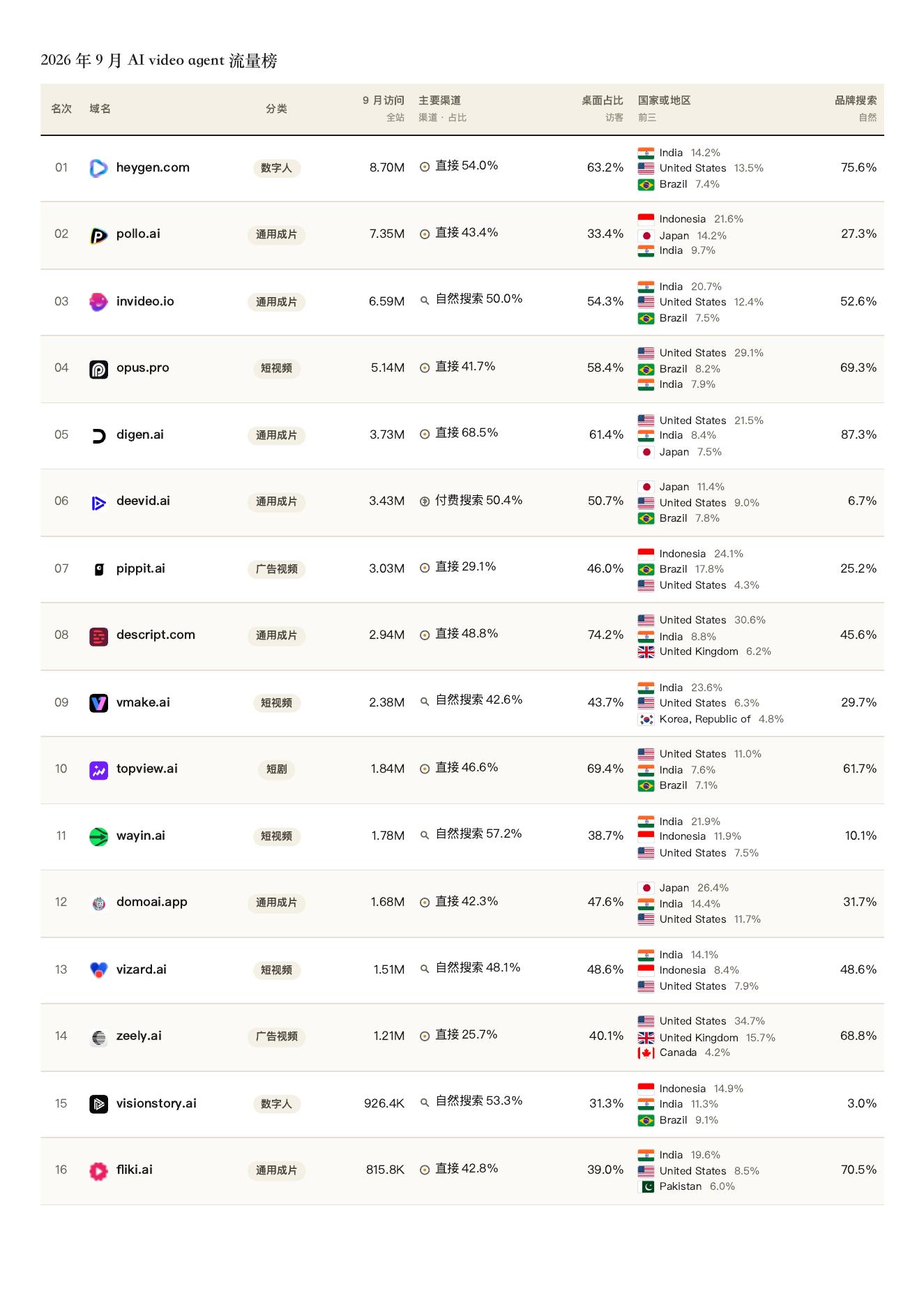
Quiet Lion’s outlook is not an annual narrative frame. Each stats month, it locks the same pool of AI video agent product sites with live checkout and publishes the latest traffic boards for that month. The current free summary covers the September 2026 window: about 63 sites in the pool, Top 50 in each PDF, three boards with different sort keys so size, growth, and absolute change stay separate—September whole-site visits, Apr→Sep growth, and visit change (Sep minus Apr). The summary shows channel structure for leading domains: heygen.com Direct-heavy, pollo.ai also Direct-heavy with a different country mix, invideo.io organic-search heavy. Figures synthesize third-party market-intelligence sources and public signals for that month. Peer benchmarking, not revenue. When the month window rolls, the boards update. Reading Quiet Lion means reading a judgment as of the latest stats month—not a once-a-year treatise.
What Quiet Lion means for investors and operators
- Investors: turn firm narrative into checkable category traffic—who rises, who falls, how channel mix differs; compare size and growth inside the same pool. When seat lists or story lists diverge from month-over-month visit gains, see also Quiet Lion’s a16z Top 100 churn vs visit-gains note.
- Operators: Direct-heavy vs Organic-heavy implies different growth playbooks; for timing, read growth and absolute-change boards together, not only #1 by size. Start with the free summary; unlock PDFs when you need exact figures.
- Shared use: use the latest monthly boards to answer who is moving in the video-agent category, then decide whether to bet on long-horizon agents, tighten governance, or rebuild infra.
Open Quiet Lion AI video agent rankings (free · latest month summary)
Where the four overlap
All four treat 2026 as a year when agents actually do work. Sequoia’s doers, a16z’s execution layer, Gartner’s adoption-intent peak, and Quiet Lion’s monthly visit boards all point to agents entering an observable stage. Chat alone is not enough: tools, memory or context, and orchestration or harnesses keep showing up; on Quiet Lion’s side that maps to whether product sites hold stable visits and checkout paths. Capability also outruns slogans—Sequoia’s diffusion gap, Gartner’s 17% vs 60%, a16z’s warning about legacy backends under agent load, and Quiet Lion boards where size ≠ growth describe one crack from different angles. In high-stakes or high-uncertainty settings, none of them want story-only decisions: a16z keeps approvals, Gartner grades levels, Sequoia says agents fail and must be repairable, and Quiet Lion asks for a monthly number check.
Where the four split
- Sequoia sounds offensive—functional AGI is here. a16z draws a map across UI, infra, verticals, and data. Gartner cools the room with peak hype, failure rates, and governance mismatch. Quiet Lion skips a total AGI definition and publishes a category traffic outlook instead.
- Readers differ: Sequoia speaks to founders and app products; a16z to builders and infrastructure; Gartner to CIOs and risk owners; Quiet Lion to investors and operators who need monthly visit checks.
- Success looks different. Sequoia asks whether you can hire an agent for fuzzy goals and sell the work. a16z watches agent-native stacks and collaboration networks. Gartner watches controlled adoption and cost that holds. Quiet Lion watches same-pool visits, growth, and absolute change for the latest month.
- Evidence differs: Sequoia uses vignettes, METR curves, and product examples; a16z uses Big Ideas themes; Gartner uses hype-cycle stages, survey percentages, and public forecasts; Quiet Lion uses three monthly traffic boards plus a free summary.
Free rankings
English: https://quietlionreport.com/en/rankings/ai-video-agent — Chinese: https://quietlionreport.com/zh/rankings/ai-video-agent . Research only; not investment advice.
Primary sources
- Sequoia Capital — 2026: This is AGI; AI Ascent 2026
- Andreessen Horowitz — Big Ideas 2026 Part 1; Agentic Interface / Voice Agents public pages
- Gartner — What the 2026 Hype Cycle for Agentic AI Reveals; 2026-05-26 governance press release
- Quiet Lion — AI video agent rankings · September 2026 summary (updated monthly)
Remaining chapters
Full text in PDF · 490 credits
The page keeps a three-chapter teaser and outline. Redeem to download the PDF — we do not expand the full article on-page.