 Quiet Lion
August 2026 · AI creative suite · site case
Pollo.ai ~6.9M visits: 45% Direct, 23% paid search—does SEO still scale?
On public global-desktop search-traffic estimates alone, Pollo.ai looks like an app-layer SEO growth story: ~597k organic vs ~84k paid—organic is the larger share inside search.
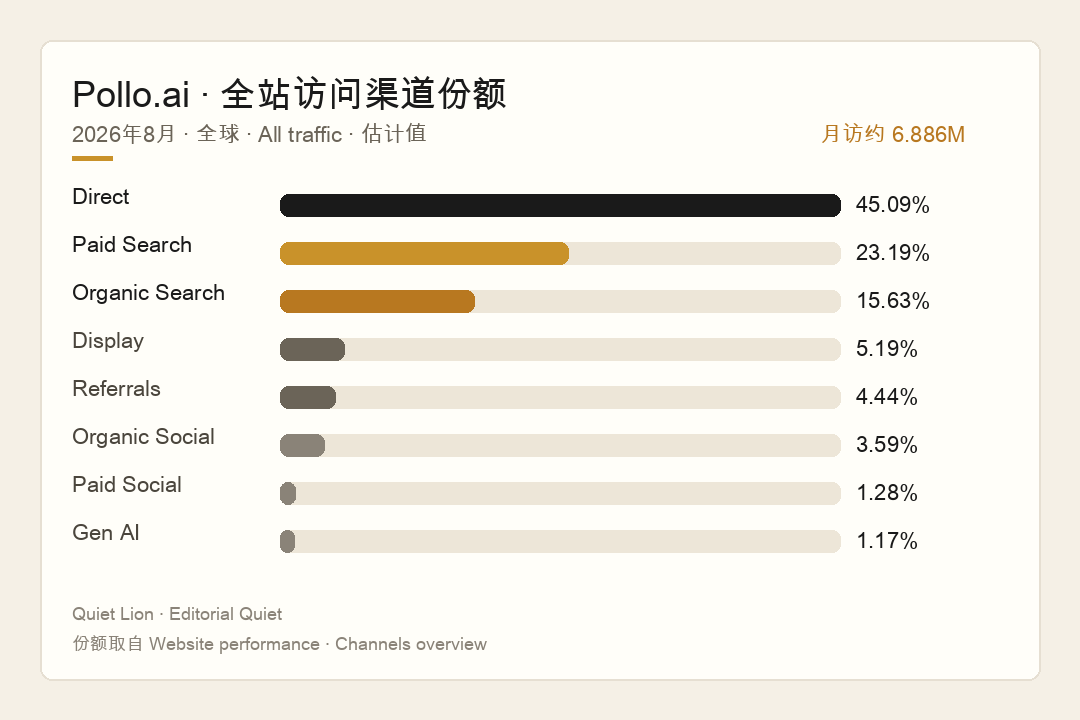
On whole-site channel mix for August 2026, monthly visits are ~6.886M: Direct ~45%, Paid Search ~23%, Organic Search ~16%. Across the whole site, return visits and paid search take the larger shares.
The two cuts do not conflict
The first describes structure inside search; the second describes whole-site channel shares. Misread the cut and you get opposite wrong conclusions: “growth is all SEO” or “SEO is useless.” Founder Abiao’s public comments point the same way: SEO is one lever beside creators and ads, and doubling again on SEO alone looks hard—the next stage is product depth and brand memory.
Product: app-layer aggregation
Pollo does not pitch itself as a foundation-model lab. Public path is multi-model aggregation toward an AI CapCut / video Canva. US landings mix tool pages with bridge pages that intercept competitor and model-name intent—evidence of a multi-entry matrix, not proof of a finished CapCut-class workflow.
Three keyword types into the site
- Brand & spelling variants → home: pollo ai (~26.5k) to /; pllo ai / polo ai likewise—users already know the brand.
- Functional long-tail → tools: ai image editor → /ai-photo-editor; image to video ai → /image-to-video—task landings must finish the job.
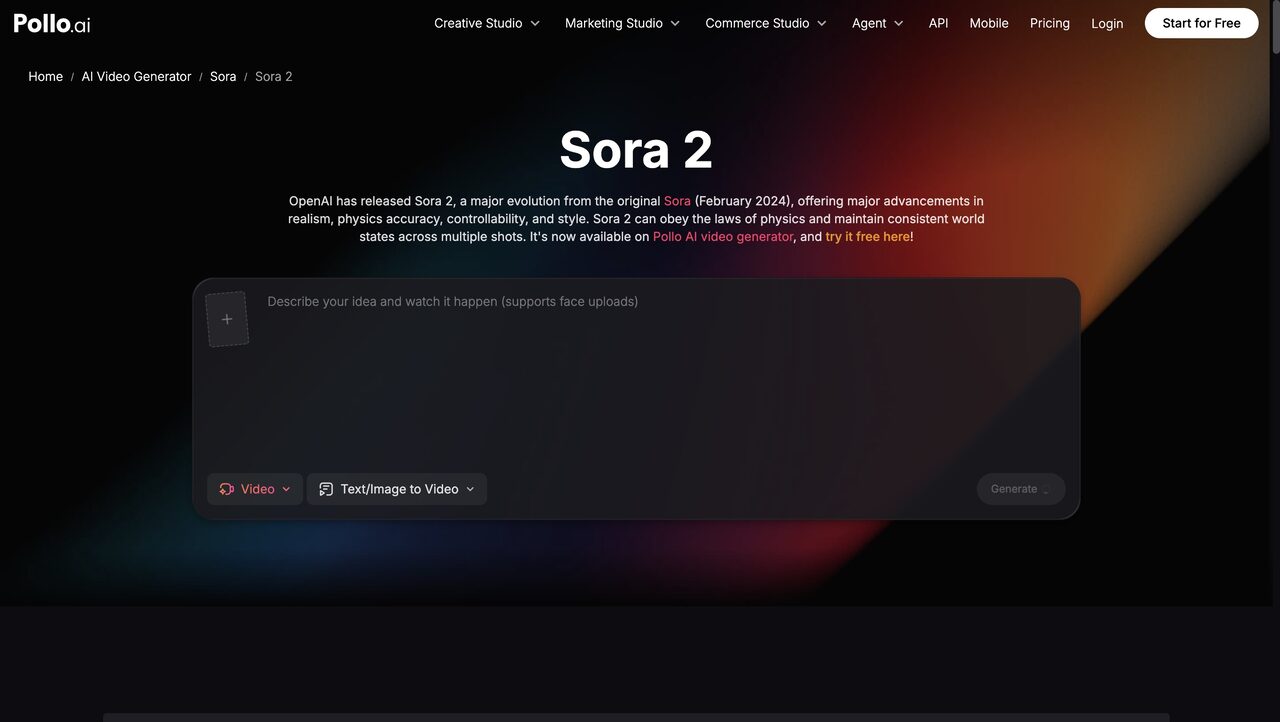
- Model/competitor names → bridges: sora 2 → /m/sora-2; civitai → /im/civitai—intercept then route into the suite; volatile when rival heat moves.

US organic vs global search
In the same month, US organic shows ~24.8k keywords (−7.9%) with ~90.9k estimated traffic (+36.5%). Global organic softens while the US window rises on fewer keywords—closer to structure and efficiency change than “SEO is dead.”
Device mix vs traffic value
Mobile Web ~68%, Desktop ~32%, with geography spanning Indonesia, Japan, Spain, India, Brazil. Mobile-heavy ≠ low-value: desktop sessions usually carry higher unit value for ads, subscriptions, and deep creation.
Monetization: what non-rolling credits imply
Unused subscription credits do not roll; Pro can top up; outbound shows payment hosts (e.g. ebanx). Non-roll pushes in-period burn; top-ups admit base packs run short; payment hosts prove a rail, not a P&L. With heavy paid search and Direct near half, monetization pressure sits on whether return users keep burning credits—not on buying a few more SEO terms.
For AIGC operators
- Search-panel “organic > paid” does not contradict whole-site “Paid Search > Organic Search.”
- Effects acquire; workflows retain. Direct ~45% means acquisition and return are both online.
- Entries can scatter (typos, tools, bridges); the post-entry workflow must converge.
The real test is whether users open pollo.ai a second and third time. Methods and more cases: Quiet Lion.
What operators usually misread
Teams often paste one search chart into a board deck and call it “the growth engine.” Pollo’s August cut shows why that fails: inside search, organic still outranks paid; across the whole site, Direct and Paid Search dominate. If you only optimize for more tool SEO pages, you may grow the search slice while the real retention question—will creators reopen the suite—stays unanswered.
Bridge pages as a controllable bet
Model-name and competitor bridges (Sora, Civitai-class intents) are acquisition tactics with measurable upside and measurable volatility. When rival heat fades, bridge traffic fades with it. Treat bridges as campaigns with owners and kill criteria, not as permanent brand equity.
Credits policy as operating design
Non-rolling credits plus visible top-ups encode a burn rhythm. Combined with Direct near 45%, the commercial question is whether return sessions keep consuming—not whether another long-tail keyword can be ranked this quarter.
Quiet Lion’s method is to keep search estimates and whole-site channel shares on separate lines, then ask one operator question: what must be true for the second open?
Remaining chapters
Full text in PDF · 490 credits
The page keeps a three-chapter teaser and outline. Redeem to download the PDF — we do not expand the full article on-page.